
NFL odds show the potential return from a winning bet and indicate how an outcome is priced by the bookmaker. You’ll find odds across virtually every market available for NFL betting, from moneylines, point spreads and game totals to player props and season-long futures.
For gamblers in the UK, NFL betting odds are usually displayed in decimal format, although American odds are also common in US betting coverage. Understanding how these prices work, what the different NFL betting lines mean and why odds change can make it much easier to assess and compare potential bets.
In this guide, we explain how to read NFL and American football odds, the different types of odds you’ll encounter and how to compare prices between bookmakers before placing a bet.
How Do NFL Odds Work?
NFL odds tell you two important things: the potential return from a winning bet and the probability a bookmaker has effectively assigned to an outcome. Generally, the shorter the odds, the more likely the outcome is considered to be, while longer odds indicate a less likely outcome and offer a larger potential return.
For example, imagine a bookmaker offers the following odds on the winner of an NFL game:
| Selection | Decimal Odds | £10 Bet Returns |
| Eagles | 1.60 | £16 |
| Cowboys | 2.40 | £24 |
A £10 bet on the Eagles at odds of 1.60 would return £16 if successful, your £10 stake plus £6 profit. The same stake on the Cowboys at 2.40 would return £24, consisting of your £10 stake and £14 profit.
The Eagles have shorter odds because they are priced as the more likely winner, while the Cowboys have longer odds because they are priced as less likely to win. However, odds shouldn’t be treated as a precise prediction of what will happen. Bookmakers build a margin into their prices, and NFL betting odds can change as new information and betting activity affect the market.
How to Calculate Implied Probability from NFL Odds
You can convert decimal NFL odds into an implied probability, which shows the percentage chance represented by the price.
The calculation is:
Implied probability = (1 ÷ decimal odds) × 100
For example, decimal odds of 2.00 represent an implied probability of 50%:
(1 ÷ 2.00) × 100 = 50%
At odds of 1.60, the implied probability is 62.5%, while odds of 2.40 imply approximately 41.7%.
| Decimal Odds | Implied Probability |
| 1.50 | 66.7% |
| 1.60 | 62.5% |
| 2.00 | 50% |
| 2.40 | 41.7% |
| 3.00 | 33.3% |
You may notice that the implied probabilities for every outcome in a market can add up to more than 100%. The amount above 100% is known as the overround and is one way of expressing the bookmaker’s margin. This is why implied probability shouldn’t be treated as the exact or “true” probability of an outcome occurring.
Understanding implied probability is useful when comparing NFL odds, as it allows you to look beyond the potential payout and consider what the price suggests about the likelihood of an outcome.
How to Read NFL Betting Odds in the UK
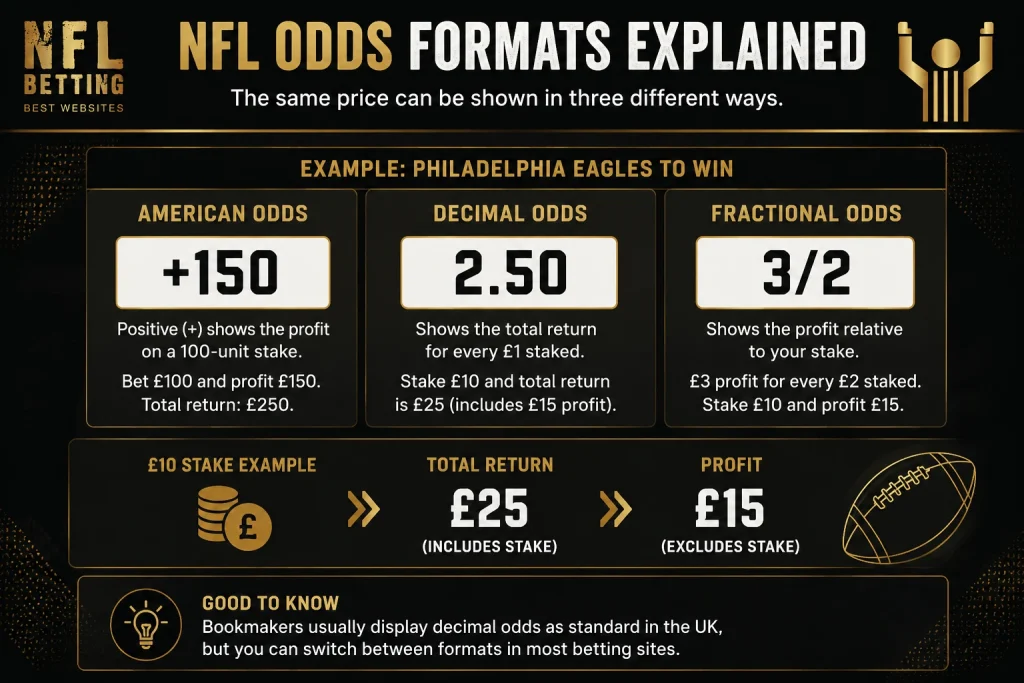
Decimal odds are a common way for gamblers in the UK to view NFL betting odds, although bookmakers generally also allow you to switch between decimal, fractional and American formats. All three formats represent the same underlying price, they simply express the potential return differently.
American odds are particularly useful to understand when betting on the NFL because they are widely used by US sportsbooks, broadcasters and NFL betting coverage. If you see a price such as -150 or +200, it can be converted into the decimal odds more commonly displayed by UK betting sites.
Decimal Odds
Decimal odds show the total return for every £1 staked, including your original stake.
For example, if an NFL selection is priced at 2.50, a £10 winning bet would return:
£10 × 2.50 = £25
That consists of your £10 stake plus £15 profit.
Shorter decimal odds indicate a higher implied probability and a smaller potential return. For example, a £10 bet at 1.50 returns £15, whereas the same stake at 3.00 returns £30 if successful.
This makes decimal odds particularly straightforward when comparing NFL prices, as you can calculate the potential return by multiplying your stake by the displayed odds.
American Odds
American odds use positive and negative numbers rather than decimals. You’ll frequently encounter this format when reading US-based NFL analysis or looking at betting lines quoted in American media.
Positive odds (+) show the profit relative to a 100-unit stake.
For example:
+150 means a £100 winning bet would make £150 profit, giving a total return of £250.
Negative odds (-) show how much you would need to stake to make 100 units of profit.
For example:
-150 means you would need to stake £150 to make £100 profit, giving a total return of £250.
You don’t need to bet £100 or £150 to use American odds, those figures simply provide the basis for expressing the price. UK bookmakers that offer different odds formats will normally convert the price automatically when you select your preferred display.
Fractional Odds
Fractional odds show the potential profit relative to your stake and remain familiar to many UK gamblers.
For example, 2/1 means you can make £2 profit for every £1 staked. A £10 winning bet at 2/1 would therefore make £20 profit and return £30 in total.
Similarly, odds of 1/2 mean you can make £1 profit for every £2 staked. A £10 bet at 1/2 would return £15, including £5 profit and your original £10 stake.
Although fractional odds are commonly associated with UK betting, decimal odds can make it easier to compare NFL and American football odds, particularly when looking across several markets or bookmakers.
NFL Odds Formats Compared
The table below shows how equivalent prices appear in each of the three main formats:
| American Odds | Decimal Odds | Fractional Odds | Implied Probability |
| -200 | 1.50 | 1/2 | 66.7% |
| +100 | 2.00 | Evens | 50% |
| +150 | 2.50 | 3/2 | 40% |
| +200 | 3.00 | 2/1 | 33.3% |
Changing the format doesn’t change the value of the bet. +200, 3.00 and 2/1 all represent the same betting price; only the way the odds are displayed is different.
For UK gamblers, the simplest approach is generally to use whichever format you find easiest to understand. However, knowing how American odds work can be particularly useful when following NFL coverage from the US, where moneyline, point spread and totals prices are frequently expressed in this format.
Types of NFL Betting Odds
NFL odds are available across a wide range of betting markets, from simply backing a team to win, to predicting player statistics or the total number of points scored. Each market works differently, so understanding what the line and price represent is important before placing a bet.
The main types of NFL betting odds you’ll encounter at UK bookmakers include moneylines, point spreads, over/unders, player props and futures.
NFL Moneyline Odds
A moneyline bet is a wager on which team will win the game. Unlike a point spread, there is no handicap to consider, if the team you back wins, the bet wins.
For a more detailed explanation of how this market works, see our guides to moneyline bets.
NFL Point Spread Odds
Point spread betting gives one team a points handicap, creating a market based on the margin of victory rather than simply which team wins.
A spread could look like this:
| Selection | Spread | Decimal Odds |
| Eagles | -3.5 | 1.91 |
| Cowboys | +3.5 | 1.91 |
Point spreads are one of the most common forms of NFL spread betting. Our guide to spread betting in American football explains the market, including favourites, underdogs and how different spreads affect your bet.
NFL Over/Under Odds
An over/under bet, also known as a totals bet, is based on whether a particular statistic will finish above or below a line set by the bookmaker.
For an NFL game’s total points, you might see:
| Selection | Total | Decimal Odds |
| Over | 47.5 | 1.91 |
| Under | 47.5 | 1.91 |
Totals aren’t limited to the final score. Similar over/under lines can also be used for team totals and individual player statistics.
See our NFL over/under betting guide for a more detailed explanation of how totals markets work.
NFL Prop Bet Odds
NFL player props are one of the most common types of prop bets and allow you to bet on the performance of an individual player rather than the final result of the game.
Because the available markets and lines can vary between bookmakers, both the statistical line and the odds attached to it are worth checking before placing a wager.
Our NFL player prop bets guide covers the different types of player and game props in more detail.
NFL Futures Odds
NFL futures are longer-term markets that are settled later in the season rather than at the end of a single game.
Common futures markets can include:
- Super Bowl winner
- conference winner
- division winner
- regular-season awards
- season win totals
Futures odds can change considerably as the season progresses. Team performance, injuries, results and changes in the likelihood of reaching the playoffs can all affect the prices available.
Our Super Bowl betting guide covers Super Bowl markets and odds in more detail.
NFL Draft Odds
American football betting isn’t limited to games and season outcomes. UK bookmakers may also offer betting markets on the NFL Draft.
Draft markets work differently from standard NFL game odds because prices can react to information released before the event, including team needs and developments in expectations around prospective picks.
Our NFL Draft betting guide explains the different markets and how NFL Draft odds work in more detail.
What Do NFL Betting Lines Mean?
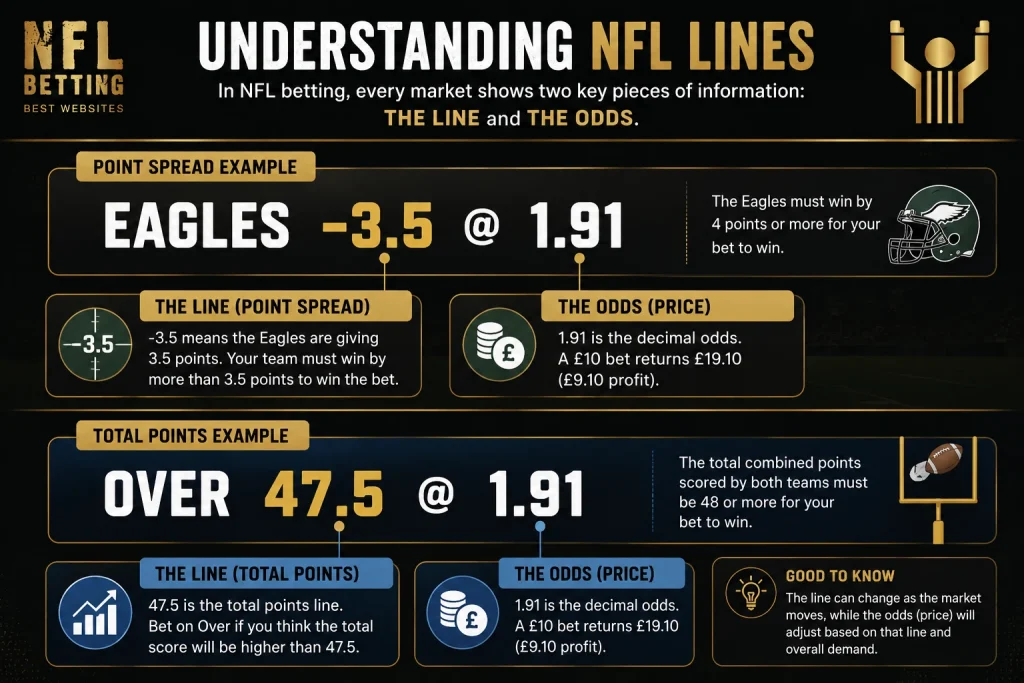
An NFL betting line is the number a bookmaker sets for a market, while the odds are the price offered on either side of that line. Although the terms NFL betting lines and NFL odds are sometimes used interchangeably, they don’t always mean the same thing.
For example, a point spread might be displayed as:
Eagles -3.5 at 1.91
In this example, -3.5 is the betting line, while 1.91 is the odds. The line sets the threshold or handicap for the bet, while the odds determine the potential return if it wins.
NFL betting lines appear across several markets. A bookmaker could set a 47.5-point line for the total score of a game, a 74.5-yard line for a player’s rushing yards or a 3.5-point spread between two teams. Odds are then attached to the available selections on either side of those lines.
| NFL Market | Example Line | Example Odds |
| Point spread | Eagles -3.5 | 1.91 |
| Game total | Over 47.5 points | 1.91 |
| Rushing yards | Over 74.5 yards | 1.90 |
Two bookmakers may offer the same odds but different lines, or the same line at different odds, so looking only at the displayed price doesn’t always give you the full picture.
Why Do NFL Odds Change?
NFL odds and betting lines can change between the time a market opens and the start of a game. Bookmakers can adjust their prices as new information becomes available, betting activity changes and the wider market reacts, so the odds you see when betting opens may be different from those available closer to kick-off.
Several factors can contribute to NFL odds moving:
- Team news: Changes to expected line-ups due to injuries, suspensions and other information about player availability can cause bookmakers to reassess a market.
- Weather conditions: Wind, rain, snow and other conditions can influence expectations for how a game may be played, potentially affecting totals and other markets.
- Betting activity: The amount and type of betting activity on a market can contribute to bookmakers adjusting their lines or prices.
- New information: Any development that changes expectations about a game can be reflected in the betting market as bookmakers and bettors react.
An adjustment doesn’t always mean the underlying betting line has to change. For example, a bookmaker could keep a team at -3.5 but change its odds from 1.91 to 1.80. Alternatively, the price could remain similar while the point spread moves from -3.5 to -4.5.
The same principle applies to other NFL markets. A game total might move from 47.5 to 48.5 points, while a player’s rushing-yard line could change after information about their expected role or availability becomes clearer.
Line movement can provide useful information about how an NFL betting market has changed, but it doesn’t tell you what will happen in the game. Shortening odds don’t guarantee that a selection will win, just as drifting odds don’t necessarily mean it will lose. The latest price simply reflects the market available at that particular time.
How to Compare NFL Odds
NFL odds can vary between bookmakers, even when they are offering exactly the same betting market. Comparing prices before placing a bet allows you to see whether another bookmaker is offering a better potential return on the same selection.
For example, using the Philadelphia Eagles vs Dallas Cowboys game from the 2025 season as a pricing example, we picked three of our best NFL bookmakers to compare the decimal odds on Philadelphia to win:
| Bookmaker | Philadelphia Eagles Odds | £20 Bet Returns | Profit |
| BetVictor | 1.80 | £36.00 | £16.00 |
| BOYLE Sports | 1.85 | £37.00 | £17.00 |
| NetBet | 1.91 | £38.20 | £18.20 |
In each case, you’re betting on the same outcome with the same £20 stake. However, taking odds of 1.91 instead of 1.80 would increase the potential return by £2.20 if Philadelphia won.
Differences like this can appear small on an individual wager, but consistently taking a higher price means receiving a greater potential return when your selections are successful.
Compare the Line as Well as the Odds
The highest odds don’t necessarily represent the better option if the bookmakers are offering different betting lines. This is particularly important with point spreads, totals and player props.
Using the same Eagles-Cowboys matchup as an example:
| Bookmaker | Philadelphia Point Spread | Odds |
| BetVictor | Eagles -3.5 | 1.85 |
| BOYLE Sports | Eagles -4.5 | 1.91 |
BOYLE Sports is offering the higher price in this example, but Philadelphia would need to cover a larger point spread. The two bets therefore aren’t identical.
The same principle applies to an over/under moving from 47.5 to 48.5 or a player’s rushing line changing from 74.5 to 76.5 yards. When comparing NFL betting odds, check both the price and the conditions attached to the wager rather than looking for the largest number alone.
Compare NFL Odds Across Betting Sites
Having access to more than one bookmaker makes it easier to compare NFL odds because prices, betting lines and available markets can differ between sites.
This can be particularly relevant for markets such as player props, where one bookmaker may offer a different line or selection of markets from another. The same applies to point spreads, totals, futures and other American football betting markets.
Odds are therefore one factor to consider when choosing where to place an NFL bet, alongside the markets available and the overall betting experience. You can compare top NFL betting sites in our dedicated guide to see how UK bookmakers differ for American football betting.
NFL Odds and Betting Value
When assessing NFL odds, a shorter price doesn’t automatically represent a better bet, just as longer odds aren’t necessarily poor value. What matters is how the price compares with the likelihood of the outcome occurring.
This is the basic idea behind betting value. A bet may offer value when your estimated probability of an outcome is higher than the probability implied by the bookmaker’s odds.
For example, imagine an NFL team is available at decimal odds of 2.50. Those odds represent an implied probability of 40%:
(1 ÷ 2.50) × 100 = 40%
If you estimated that the team’s actual chance of winning was 50%, you would consider the 2.50 price to offer value because your assessment of its probability is higher than the 40% represented by the odds.
That doesn’t mean the bet will win. Even if your assessment were accurate, an outcome with a 50% probability could still lose on any individual occasion. Betting value is therefore about the relationship between price and probability, rather than predicting the result of a single NFL game.
Where Can You Find NFL Odds in the UK?
NFL odds are available from a range of online betting sites in the UK, with markets offered across the regular season, playoffs and major events such as the Super Bowl.
The exact markets, betting lines and prices available can differ between bookmakers, so the choice of betting site can affect both what you can bet on and the odds you receive.
Our best NFL betting sites guide compares bookmakers for American football betting, including the NFL markets they offer and other factors worth considering when choosing where to bet.
NFL Odds FAQs
What are NFL odds?
NFL odds are the prices bookmakers attach to American football betting markets. They show the potential return from a successful bet and can also be converted into an implied probability for the outcome.
How do NFL odds work in the UK?
UK gamblers can usually view NFL odds in decimal, fractional or American format. Decimal odds show the total return for each £1 staked, including the original stake.
What do plus and minus NFL odds mean?
Plus and minus signs are used with American odds. Positive odds, such as +150, show the profit relative to a 100-unit stake. Negative odds, such as -150, show how much needs to be staked to make 100 units of profit.
What does +3.5 mean in NFL betting?
A +3.5 point spread gives the selected team a 3.5-point handicap for betting purposes. The bet wins if that team wins the game outright or loses by three points or fewer.
Why do NFL betting odds change?
NFL betting odds can change as bookmakers respond to factors such as injuries, team news, weather, betting activity and wider market movements.
Are American football odds the same as NFL odds?
NFL odds are American football odds specifically relating to the National Football League. American football betting can also cover other competitions, most notably college football betting, so not all American football odds relate to the NFL.