
NFL moneyline betting is one of the simplest ways to bet on American football. Instead of predicting a winning margin or total number of points, you choose which team will win the game.
Each team is given a price based on its perceived chance of winning. The stronger favourite normally has shorter odds, while the underdog offers a larger potential return.
For UK bettors, moneyline selections are usually displayed using decimal odds, although American odds such as -200 and +170 are also common when reading NFL analysis or viewing US betting content.
This guide explains how NFL moneyline betting works, how to read the odds, how favourites and underdogs are priced and how moneyline bets differ from point spreads and totals.
If you’re new to NFL wagering generally, start with our guide to betting on American Football games.
What Is a Moneyline Bet in NFL Betting?
An NFL moneyline bet is a wager on which team will win the game. There is no point spread for the team to cover, and the size of the winning margin does not affect the result of the bet.
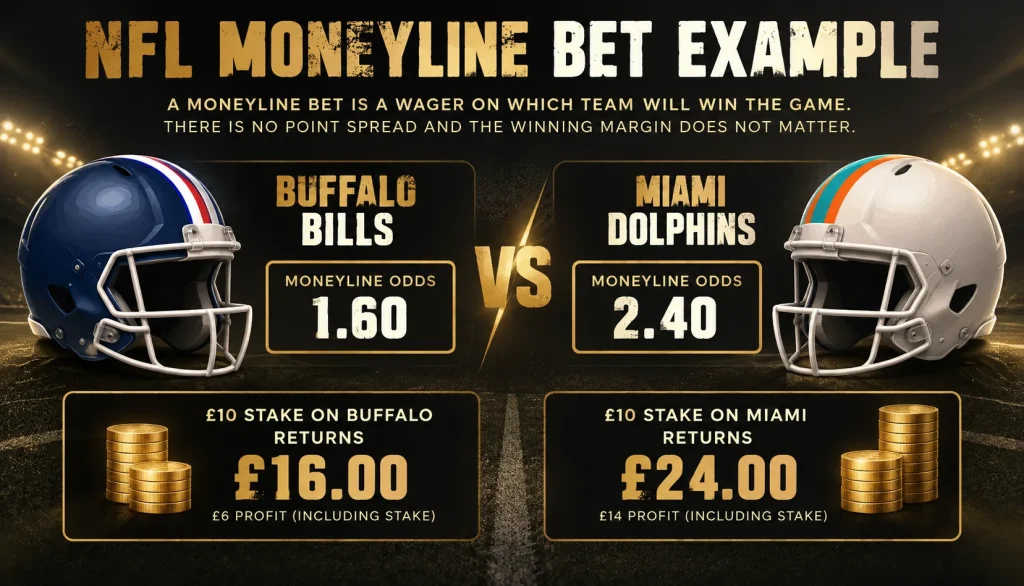
For example, imagine an NFL game is priced as follows:
| Team | Moneyline odds |
| Buffalo Bills | 1.60 |
| Miami Dolphins | 2.40 |
A £10 moneyline bet on Buffalo at 1.60 would return £16 if Buffalo won the game, including the original £10 stake.
A £10 bet on Miami at 2.40 would return £24 if Miami won.
The difference between the two prices reflects the market’s assessment of how likely each team is to win. In this example, Buffalo is the favourite and Miami is the underdog.
How Does NFL Moneyline Betting Work?
When placing an NFL moneyline bet, you select the team you expect to win rather than applying a points handicap.
The bookmaker attaches odds to both teams. Those odds determine both the potential return and the implied probability associated with each selection.
Using the same example:
| Team | Decimal odds | £10 stake | Total return | Profit |
| Buffalo Bills | 1.60 | £10 | £16 | £6 |
| Miami Dolphins | 2.40 | £10 | £24 | £14 |
The calculation with decimal odds is:
Stake × decimal odds = total return
So:
£10 × 1.60 = £16
and:
£10 × 2.40 = £24
A shorter price produces a smaller return because the selection is considered more likely to win. A longer price offers a larger return because the outcome is considered less likely.
The odds are not simply a prediction of the result. They are betting prices and also include a bookmaker margin.
NFL Moneyline Favourites and Underdogs
Every moneyline market will normally have a favourite and an underdog unless both teams are priced very closely.
Moneyline favourite
The favourite is the team given the shorter odds.
If one team is available at 1.45 and the other at 2.90, the 1.45 selection is the favourite.
Shorter odds indicate a higher implied probability, but being the favourite does not mean the team is guaranteed to win.
Moneyline underdog
The underdog is priced at longer odds because the market considers it less likely to win.
An underdog at 3.00, for example, offers a larger potential return than a favourite at 1.50.
That does not automatically make the underdog a better bet. The relevant question is whether the odds accurately reflect the probability of the outcome.
How to Read NFL Moneyline Odds
NFL moneyline prices can be displayed differently depending on the bookmaker or source you are using.
UK betting sites generally use decimal odds, while American NFL coverage frequently displays moneyline prices in the US format.
Decimal Moneyline Odds
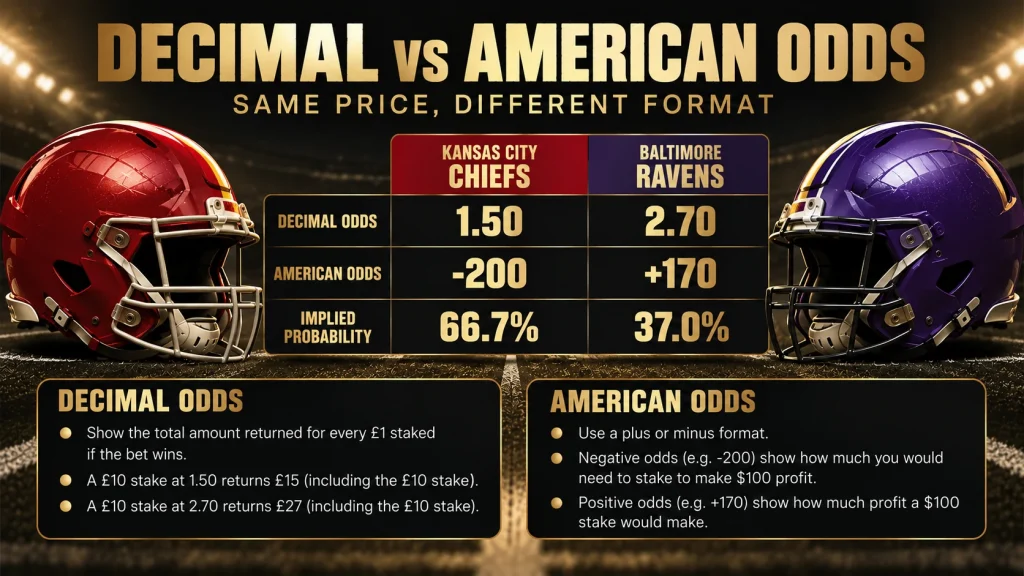
Decimal odds show the total amount returned for every £1 staked if the bet wins.
For example:
Kansas City Chiefs — 1.50
A £20 stake would produce:
£20 × 1.50 = £30 total return
The £30 includes:
- £20 original stake
- £10 profit
Another example:
Las Vegas Raiders — 3.20
A £20 winning stake would return:
£20 × 3.20 = £64
That consists of the £20 stake plus £44 profit.
American Moneyline Odds
American odds use positive and negative numbers.
You might see a market displayed as:
| Team | American odds |
| Kansas City Chiefs | -200 |
| Las Vegas Raiders | +170 |
Negative odds identify the amount that would theoretically need to be staked to make $100 profit.
At -200, a $200 winning stake would make $100 profit.
Positive odds indicate how much profit a theoretical $100 stake would make.
At +170, a $100 winning bet would make $170 profit.
UK bettors do not need to use American odds when placing bets with most UK bookmakers, but understanding them is useful because they appear frequently in NFL media, statistics and betting analysis.
Converting American Moneyline Odds to Decimal Odds
Approximate conversions for the example above would be:
| American | Decimal |
| -200 | 1.50 |
| +170 | 2.70 |
If you regularly compare US and UK prices, decimal conversion makes it easier to compare the actual potential return.
Our American Football betting odds guide covers decimal odds, American odds and implied probability in more detail.
NFL Moneyline Betting Example
Consider a hypothetical game between the Green Bay Packers and Chicago Bears.
The market is:
| Selection | Decimal odds | American odds |
| Green Bay Packers | 1.50 | -200 |
| Chicago Bears | 2.70 | +170 |
A £20 moneyline bet on Green Bay at 1.50 would return:
£20 × 1.50 = £30
That means a £10 profit if Green Bay wins.
A £20 moneyline bet on Chicago at 2.70 would return:
£20 × 2.70 = £54
That would produce a £34 profit if Chicago wins.
The larger Chicago return does not mean that selection is automatically preferable. It reflects the fact that Chicago is being priced as the less likely winner in this hypothetical market.
The central point with a moneyline wager is simple: the selected team must win the game under the bookmaker’s settlement rules.
NFL Moneyline vs Point Spread Betting
Moneyline and point spread bets both involve choosing a team, but the conditions for winning the bet are different.
| Moneyline | Point spread | |
| Main question | Which team will win? | Will the team beat the handicap? |
| Winning margin matters | No | Yes |
| Uses a points handicap | No | Yes |
| Favourite and underdog reflected through | Mainly the odds | Spread and odds |
| Example | Bears to win | Bears +6.5 |
Suppose Chicago is a 6.5-point underdog.
You could place either:
Chicago moneyline
or:
Chicago +6.5
If Chicago loses 24-21:
- the Chicago moneyline bet loses because Chicago did not win;
- Chicago +6.5 wins because the three-point defeat is inside the 6.5-point handicap.
If Chicago wins outright, both bets would normally win.
Read our full guide to spread betting for a more detailed explanation of NFL handicaps.
Moneyline vs Over/Under Betting
An NFL moneyline bet concerns which team wins.
An NFL over/under bet concerns how many combined points are scored.
For example:
Kansas City Chiefs moneyline
Kansas City must win the game.
Over 47.5 points
The two teams must combine for at least 48 points.
The winner of the game does not matter for the over/under selection.
This distinction is useful because moneyline, spreads and totals represent three different ways of betting on the same NFL matchup.
What Happens to a Moneyline Bet if an NFL Game Is Tied?
NFL regular-season games can finish in a tie, so it is important to check how the bookmaker defines and settles the market.
Settlement can depend on whether the bookmaker offered:
- a two-way moneyline;
- a three-way market including the tie;
- a market defined around regulation time;
- a market that includes overtime.
Bookmaker rules can also differ.
For that reason, bettors should check the settlement terms attached to the specific market rather than assume that every NFL moneyline bet is treated in exactly the same way after a tie.
The same applies to postponed, abandoned or rescheduled games.
Can You Use NFL Moneyline Bets in Accumulators and Bet Builders?
Moneyline selections can commonly be included in accumulators and Bet Builders where the bookmaker permits the combination.
For example, a Bet Builder might include:
- Cincinnati Bengals moneyline
- over 44.5 total points
- a quarterback to throw for 250+ yards
The bookmaker determines which selections can be combined and how correlated markets are priced.
Our NFL Bet Builder guide explains how these same-game combinations work in more detail.
Why Do NFL Moneyline Odds Change?
Moneyline prices are not fixed permanently when a market opens.
Odds can move as bookmakers respond to new information and changes in the betting market.
Factors can include:
- injuries and player availability;
- quarterback changes;
- team news;
- weather conditions;
- betting activity;
- changes elsewhere in the market;
- differences in how individual bookmakers assess the matchup.
Suppose a team initially opens at 1.80 and later moves to 1.65.
The shorter price indicates that the market now associates that selection with a higher implied probability than it did previously.
That does not guarantee the team will win. Odds movement describes a change in price, not certainty about the result.
For a broader explanation of how NFL prices work, see our guide to NFL betting odds.
Comparing NFL Moneyline Odds Between Betting Sites
Different bookmakers can offer different moneyline prices on exactly the same team.
Consider these hypothetical prices for a Kansas City Chiefs moneyline:
| Betting site | Chiefs moneyline | Return from £20 |
| BOYLE Sports | 1.55 | £31 |
| NetBet | 1.60 | £32 |
| Betfred | 1.65 | £33 |
The selection is identical in each case, but the potential return differs.
At 1.55:
£20 × 1.55 = £31
At 1.65:
£20 × 1.65 = £33
That is a £2 difference in return from the same £20 winning stake.
The example illustrates why comparing prices can matter even when several betting sites offer the same NFL market.
The figures above are illustrative rather than current bookmaker odds.
You can compare operator features and NFL market coverage in our guide to the best NFL betting sites.
NFL Moneyline Betting and Implied Probability
Betting odds can also be expressed as an implied probability.
With decimal odds, the basic calculation is:
1 ÷ decimal odds × 100 = implied probability
Examples:
| Decimal odds | Implied probability |
| 1.50 | 66.7% |
| 2.00 | 50% |
| 2.50 | 40% |
| 3.00 | 33.3% |
A team priced at 1.50 therefore has an implied probability of approximately 66.7% before considering how the bookmaker margin affects the market.
This is important because odds are more than a measure of potential winnings.
A 1.50 selection and a 3.00 selection represent very different market expectations.
Why the probabilities can total more than 100%
If you convert both sides of a bookmaker’s moneyline market into implied probabilities, the total may exceed 100%.
That difference is associated with the bookmaker’s margin.
For example:
Team A — 1.80
1 ÷ 1.80 × 100 = 55.6%
Team B — 2.10
1 ÷ 2.10 × 100 = 47.6%
Combined:
55.6% + 47.6% = 103.2%
This does not mean the game somehow has a 103.2% chance of producing a winner. It reflects the pricing structure of the betting market.
Advantages and Limitations of NFL Moneyline Betting
Moneyline betting is straightforward, but its characteristics differ from other NFL markets.
| Feature | What it means |
| Simple result condition | You are primarily betting on which team wins |
| No point spread | The team does not need to cover a handicap |
| Winning margin usually irrelevant | A one-point win and a 20-point win settle the moneyline the same way |
| Favourites can be short-priced | Strong favourites may offer relatively small potential returns |
| Underdogs offer bigger returns | Longer odds reflect a lower implied probability |
| Prices vary between bookmakers | The same team can be available at different odds |
| Settlement rules matter | Ties and unusual game circumstances can be handled differently |
The simplicity of the market is one reason moneyline betting is often easier for beginners to understand than point spreads.
It does not, however, remove the importance of understanding the price being offered.
Common NFL Moneyline Betting Mistakes
Confusing the moneyline with the point spread
A moneyline team normally needs to win the game. It does not need to win by a particular number of points.
A spread bet works differently because the handicap affects whether the selection wins.
Assuming the favourite is automatically a good bet
A favourite may be more likely to win while still being offered at a price a bettor considers unattractive.
Likelihood and price are separate considerations.
Assuming the underdog offers better value because the return is bigger
Longer odds provide a larger potential payout because the outcome is considered less likely.
A bigger return alone does not establish value.
Ignoring differences between bookmakers
A moneyline price of 1.70 produces a larger return than 1.60 for the same stake and selection.
Comparing the available price is therefore relevant even when the underlying bet is identical.
Misreading American odds
A minus sign and a plus sign have very different meanings.
For example:
-150 represents a favourite-style American price.
+150 represents a positive underdog-style price.
They should not be interpreted simply as negative and positive versions of the same decimal number.
Not checking settlement rules
Rules surrounding ties, postponements, overtime and abandoned games can affect how a bet is settled.
Check the conditions of the specific bookmaker and market before placing the wager.
NFL Moneyline Betting FAQs
What does moneyline mean in NFL betting?
Moneyline betting means wagering on which NFL team will win the game rather than applying a point spread. The bookmaker assigns different odds to each team based on their perceived chances of winning.
How does a moneyline bet work in the NFL?
Choose one of the teams in the moneyline market and place your stake at the available odds. If that team wins according to the market’s settlement rules, the bet is settled as a winner and the return is calculated using the odds you accepted.
Do you just need the NFL team to win on the moneyline?
Usually, yes. A standard moneyline wager is based on the selected team winning rather than covering a points handicap. Bettors should still check the market definition and bookmaker rules, particularly regarding ties and overtime.
What is the difference between moneyline and point spread betting?
A moneyline bet is based on which team wins. Point spread betting applies a handicap, so a team can lose the game but still cover the spread, or win the game without covering it.
Can an NFL moneyline bet end in a tie?
NFL regular-season games can finish tied. How the wager is settled depends on the exact market and bookmaker rules, so check whether the market is two-way, includes a draw or has specific overtime conditions.
Are NFL moneyline odds shown differently in the UK and US?
Yes. UK bookmakers generally display decimal odds by default, while American NFL coverage frequently uses positive and negative American odds such as +170 and -200. Both formats represent the same underlying concept: the price of the selection.
Summary of Moneyline Betting
NFL moneyline betting removes the points handicap and focuses on the result of the game. The favourite is normally offered at shorter odds, the underdog at longer odds, and the price determines how much a winning stake returns.
Understanding that price is just as important as understanding which team needs to win. Comparing odds, recognising implied probability and knowing how the bookmaker settles the market all help you understand exactly what you are betting on before placing a moneyline wager.